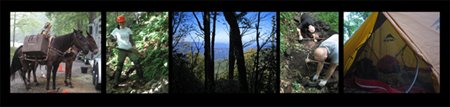
The Rocky Top crew works exclusively on 70 miles of the A.T. through the Great Smoky Mountains National Park following the ridge crest from Davenport Gap to Fontana Dam. The crew is sponsored jointly by the Smoky Mountains Hiking Club, the National Park Service, and ATC.
Showing posts with label Rocky Top. Show all posts

Wednesday, June 17, 2015


The Ultimate Post-Thru-Hike Reentry Program

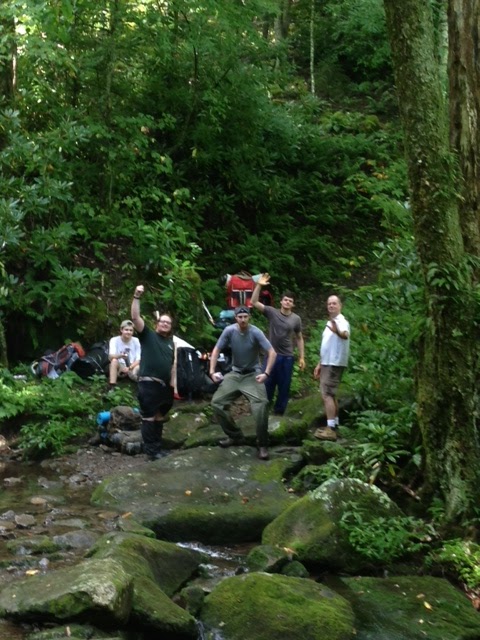
Rocky Top Trail Crew members show their enthusiasm along the Appalachian Trail in the Great Smokies//Text by Leanna Joyner, Trail Resources manager
 
Near the end of a thru-hike, or just afterwards, there’s a flood of mixed emotions: pride, elation, and for some, there’s confusion about what comes next. The camaraderie, present-moment focus, the healthy physical exertion, and time outdoors doesn’t have to conclude when your hike finishes.
 
Several thru-hikers of the Pacific Crest Trail and the Appalachian Trail (A.T.) are already planning to join the Rocky Top Trail Crew once their hike ends. Rocky Top Trail Crew enables hikers to experience the Great Smoky Mountains from a different perspective by working and camping on the Trail during 8-day sessions.
 
Here are the top 10 reasons why a hitch on crew is the perfect transition into life after the trail.
  1. Retrace part of your hike: The Smokies are beautiful, but early spring thru-hike starts often means missing the views and expansive perspective gained from some of the highest and most remote sections of the entire A.T. You’ll get to return to the Smokies in time to see the fall colors in their full effect in September and October and squeeze out the very last bit of good weather before the snow flies and puts the Trail to bed for the winter.
  1. Camaraderie: Live and work with the salt of the earth. Whether reuniting with Trail friends or other volunteers on the crew, you’ll forge the kind of memorable relationships that will last a long time.
  1. “Repair the Rut”: If you ever found yourself frustrated with a trench of trail, this is your chance to make it better for those who come behind you. Be part of improving the type of trail conditions you were annoyed by the most.
  1. Get a behind the scenes look at the management of the A.T.: The Trail doesn’t just exist. It’s constantly evolving and shifting, and it requires a host of management partners, from volunteers, to Appalachian Trail Conservancy (ATC) staff, and land management agencies. Get a glimpse of how all the pieces and partners fit together by being a valuable piece of the puzzle to protect the A.T.
  1. Learn new skills: By the end of your hike, you’ve stepped over, on, or around thousands of steps or waterbars. They are the corrective action for the number one enemy of the trail: water. These erosion control features repair entrenched trail by slowing the flow of water or by getting off the trail. Learn the “how” and the “why” behind these structures. You’ll know it well enough by the end that you can teach someone else.
  1. Continue your outdoor experience: If your experience hiking this year makes you feel like you may only ever want to live and work in the backcountry, trail crew provides a great job skill training opportunity and resume builder. Add conservation, natural resource protection, and teamwork to your skill set as you ease your way back into the workforce.
  1. Get all you can eat without tacking on those post-trail pounds: Keep your trail physique and gain upper body strength and conditioning while enjoying all the food you can eat. Did we mention you don’t even have to carry that food up the mountain to the backcountry site? Our equestrian volunteer and partners help us carry some of the heaviest equipment and supplies to the worksite on this rare horse-accessible portion of the A.T.
  1. Put your worrying mind at ease: With your backpack on, your focus is solely on the trail ahead. On crew, you can focus just on the task at hand: crushing this rock, lopping this brush, or placing the most perfect stone step. With concerted focus, your mind releases unnecessary chatter and your body produces measurable results.
  1. It feels good to give back: Altruism releases all kinds of fabulous feelings. Bring yourself and your contributions of sweat and effort to Rocky Top Trail Crew to leave a lasting impact. Plus, you’ll be delighted to plan a return visit long into the future.
  1. Earn a free t-shirt: While no one on crew cares a bit if you’re stinky as you work alongside them in your hiking gear, at the end of your crew session, you’ll appreciate having a fresh t-shirt to slip on. You’ll walk away with a t-shirt in acknowledgement of your effort and making you as a great guardian of the A.T.

Wednesday, September 24, 2014

Our Friends from Across the Pond Help Rehab the A.T.in the Smokies


This session of Rocky Top Trail Crew had a definitive British flavor, as members of the Essex Boys and Girls Club came to volunteer in Great Smoky Mountains National Park, in part to help develop their own young leaders. Two chaperones and five young men and women from the U.K., after having hiked through the Smokies the week prior, learned about sustainable structure building for trails and how to install such structures. Robert, a member of the Georgia Appalachian Trail Club and our lone volunteer from stateside, rounded out the crew for the week.


A tough section of trail that the previous week’s crew began to repair with log cribbing was finished this week, including some pinning of rocks to hold crush – man-made gravel used as a tread surfacing in order to encourage water percolation and erosion control. This bit of work required the use of rock drills and hammering in rebar to help lock the rocks in place. Later on in the week, the crew worked to lay crush over an area above old Civilian Conservation Corps crib wall, where a lack of sunlight and proper drainage over almost a century had left the trail quite soggy. Finally, the crew finished their week by completing 45 feet of locust log turnpike, a structure which raises the tread of a trail up out of a poor drainage area with the help of lots of crush and fill.


During time at camp, the crew played a variety of group games, including charades, and one night, the boys and girls from Essex successfully guessed all 50 U.S. states. The Americans on crew had a much harder time with guessing all 52 counties in the U.K. (they only got four or five). In the mornings, the crew enjoyed sunrises before leaving camp for the workday and, at the end of the day admired the orange glow of the sunsets upon the trees in camp.


Overall, the crew put in eleven log steps, one rock waterbar, one grade dip, the aforementioned turnpike, and over 128 cubic feet of crush and fill – an astounding amount of hand-made gravel for a single week. In the end the young leaders of the Essex Boys and Girls club, some of which are studying to be outdoor educators and guides, learned how to build sustainable trail and repair badly eroded aspects of the trail.

We here at Rocky Top Trail Crew hope to see our friends from across the pond make their volunteerism an annual venture and so look forward to their return next year!

Tuesday, September 16, 2014

Session 1: The Great Pack-In | First Trail Rehab of the Season

This year’s Rocky Top season in the Smokies began with a great set of volunteers, both on the trail work side and equestrians working to help us out on the horse pack-in side. On the day before the crew hiked in, members of the Backcountry Horsemen of Tennessee and North Carolina, including regional presidents Vetice Bates and Tom Thomas, brought over 300 lbs of trail tools and camping gear up to the crew’s campsite. The following day the crew hiked up Snake Den Ridge Trail, a six-mile hike gaining over 3,500 feet of elevation. More equestrian volunteers, this time from the Smoky Mountain Trail Riders, took up over 200 lbs of food and camp amenities for the crew’s first eight-day session.

The crew meets the day before their session heads into the field; the gathering at basecamp includes orientation, introductions, a safety talk, and a great dinner cooked by camp coordinator Chloe de Camara. She also prepares the crew’s camp food for the horse packers. The next morning the crew began their journey up Snake Den Ridge Trail from Cosby Campground.

 The crew carried all the gear they needed that hadn't been hauled earlier through the support of our horse partners. The volunteers the first week ranged widely in background and experience, coming together to create a well-rounded group for the crew. Jerry, a volunteer from Ohio, had spent years working in the state park system, including doing trail work. Sam, a volunteer from Virginia, had just finished a thru-hike of the trail and was ready to give back to the A.T. Having Sam's hiker appetite on crew meant there was never a scrap of food that wasn't fully enjoyed. 


The crew spent the next six days working near Inadu Knob doing major trail rehab. This included installing over twenty log and rock steps, a rock water bar, and removing a large portion of berm from the edge of the trail to allow water to shed downhill instead of being retained on the walking surface.


A particularly rooty part of the trail called for extensive log cribbing and log steps in order to control water erosion and to gain elevation over and protect larger roots. In another difficult section where bedrock created water-shedding issues, the crew constructed two tiers of rock cribbing and two rock steps in order to bring the trail over the exposed section of mountain. Throughout the duration of the week the crew of volunteers learned trail maintenance and rehab skills on-the-job and by the week’s end became very proficient trail rehabbers.


Thus Rocky Top week one ended with an impressive amount of trail work completed. However, the rest of the season in the Smokies this fall has only just begun!

To join a Rocky Top trail crew, visit appalachiantrail.org/crews

Thursday, November 14, 2013

Crew Life in the Smokies: A Comparison of Rocky Top and S.W.E.A.T Crew

This blog post is cross-posed here as well as on the S.W.E.A.T Crew blogWritten by Ron Hudnell, a first-time volunteer on S.W.E.A.T and Rocky Top, who breaks down the differences in the two crews.

Reflections from an ATC Crew “Newbie”


During October 20 – 26, 2013, I was very fortunate to be on the end-of-season session #5 of the Appalachian Trail Conservancy Rocky Top volunteer crew which did trail building projects in the Smoky Mountain National Park between Cosby Knob Shelter and Tri-Corner Knob Shelter.  The official count on new steps was 31 with a few rock bar drains and berm clearance projects, but who is counting?  We did!  Crew leaders, Bobby and Greever, said that we set a new record this year with the most steps in the shortest time with the smallest work crew – lots of superlatives in that claim!

I use the word “fortunate” above because I was the only crew member who had not done Rocky Top work before, so I felt blessed to be on a team with very experienced leaders as well as co-workers willing to come back for a second session.  Some had been back for multiple visits so I knew I was on to something!

During the shortened Rocky Top work session caused by the government shutdown, the question that I got most often asked was not about background, miles hiked on the A.T., gear, rock work knowledge, etc., but rather how I would compare work with Rocky Top to my previous work with the S.W.E.A.T. crew earlier in the season.
Rocky Top: Hammers High

So my comparison for the record and for the benefit of other volunteers who are trying to decide which group to join…

Similarities between S.W.E.A.T. & Rocky Top

  •   Both teams were absolutely and totally satisfying for me as I got to work for excellent crew leaders and with groups of very dedicated AT enthusiasts.
  • Crew leaders were well trained and very knowledgeable on trail construction/trail maintenance, had thru-hiker experience, and were strong advocates of “Leave No Trace”.  They had great practical experience! 
  • There were no disgruntled, hard-to-work-with individuals in either group.
  • Both groups did work that is very necessary for the preservation and sustainability of the Appalachian Trail
  • I was tired at the end of the day with both groups - and thus slept very well!
  • Camp Coordinator, Kayah Gaydish, did a fabulous job of working with crew leaders for both groups to ensure that each volunteer member had enough and the right foods to eat during their sessions.  She even went AAN (“above and beyond”) by hiking part way out with us on the Rocky Top week and meeting us at the equipment pickup point at the end of the week.  Very much appreciated!

S.W.E.A.T. Crew

Differences between S.W.E.A.T. & Rocky Top 

  •  The Rocky Top week involved more creativity or “engineering” as you had to determine where the steps were needed for effective erosion control as well as hiker/horse traffic, what materials the steps would be constructed of, where you were going to find and move the materials, how to cut the stone, how deep to dig the holes, and more.  (By the end of the week, my mentor said he had taught me all he could so I was on my own.  But I did catch him looking over his shoulder just to ensure “our trail” projects would be approved by the crew leader.)  I really enjoyed the interaction among crew members in these “design” activities. 
  • The S.W.E.A.T. crew activity was more maintenance-oriented on existing sites, so the physical count accomplishment list was much higher.
  • Rocky Top was more physically demanding once on site as you seemed to always have a rock sledge or hammer in your hand if you were not moving a large rock!  But pack horses carried up and brought down food, equipment, and tools thus aking a big load off the volunteers.
  • S.W.E.A.T. was more physically demanding getting to and from the work site as the hike in was longer and crew members hiked all tools and food in and back.  In a somewhat strange way, I liked that physical challenge/accomplishment of carrying a 65 lb pack!

S.W.E.A.T. Team

The Bottom Line

It will be difficult for me to pick between these two groups – S.W.E.A.T. or Rocky Top – so I am sure that I will attempt to do both groups again next year if ATC will allow me to do so.  I might even expand my horizon by looking at some other ATC crews (the Konnarock Crew was often mentioned) as well as at some local weekend A.T. trail maintenance organizations!

Rocky Top Team


Thank you ATC for allowing me to be a part of both groups this year!  I encourage all hikers and AT supporters – financial or otherwise – to get involved with a trail crew as ATC staff cannot alone maintain the trail that we so love.  And the personal returns are lifelong…

Ron Hudnell

AKA “Tarheel”

Thursday, September 26, 2013

Session Two: Rough Around the Edges

Rough around the edges describes my video editing than the crew for session two. This team worked seamlessly together to get a heck of a lot of work done.

During my visit to the work site, I saw the work that our session one folks had achieved, as well as the steady progress being made by session two. It's amazing to see it all come together. I hope the video captures it for you.

The embedded video doesn't look nearly as crisp as it does on YouTube, so you may prefer to watch it there.

Wednesday, September 4, 2013

Session One Underway

Session One of Rocky Top Trail Crew kicked off on September 1. The crew met the evening before at base camp for orientation and dinner.

Before dawn, the crew's camp coordinator awoke to prep breakfast - a french toast-inspired dish and sausage meatballs. Well fed and fueled, the crew packed up their lunches, then loaded their packs in the van that took them to Cosby Campground. (Here is John's praise of his Rocky Top Crew base camp breakfast...)

At Cosby the crew met the teams of horse packers who volunteer with Rocky Top to take up essential supplies, like tents, an electric fence to keep bears away from the crew's mountain-top kitchen, food, tools, and a few comforts - like foldable camp chairs (the closest thing to car-camping our crew volunteers will experience during their week on crew. Otherwise, it's rugged.)
David & Noland Richards
Packin' Front and Center
The team of horse packers started up the Snake Den Ridge Trail at 10:00 a.m. The crew, laden with their backpacks and a few tools, followed behind. Snake Den Ridge Trail is a tough trail for our volunteers and the horses. Horsemen condition their horses for the ride. Volunteers also have to come ready for the challenge of climbing more than 3,400 feet in about 5.5 miles (although the distance from the parking lot makes the hike closer to 6 miles). The morning was muggy and the temperatures were warming.The crew got spread out over the first two miles but took the opportunity to regroup at the Inadu Creek crossing where everyone got the chance to dip fingers in the cold, refreshing water, and eat a snack.

At Inadu Creek

The crew continued on their climb. Steadily making progress. Putting one foot in front of the other. Simultaneously halting and persevering, they willed themselves up the mountain. Then, the thunderstorm arrived. With the rain came the wind. The torrent blew over in about a half hour, but left the crew soaked. Luckily their spirits hadn't been drenched.

Keith admiring the cribbing at Inadu Creek
Onward they climbed. They took a break at a wide switchback, designed by nature with large sitting rocks for resting. While there, a set of horse packers returned from unloading at the campsite. After they continued on, the crew gathered up and pressed on toward the A.T. The most difficult part of Rocky Top Crew can be just getting to the work site. It is not an easy climb. The crew soldiered on, eventually making it to camp just before night fall.

The real work would start the next day: rehabilitating the Appalachian Trail, one stone or rock step at a time.